Thursday, 27 October 2016

Posters


Heinz Schulz - Neudamm
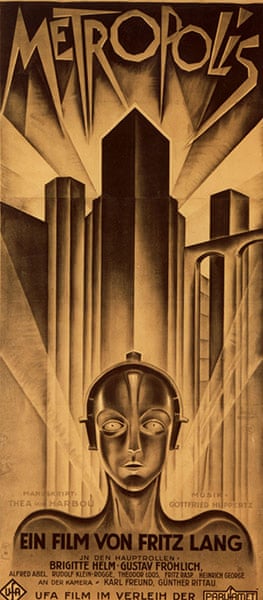
- 'Metropolis'
1927
This is a poster created for the 'Metropolis' film which was released in 1927, this cleverly designed due to the use of geometrical shapes and a sharp, piercing font for the title. I feel that this poster is very striking due to the elements of design within it, because it is set in a futuristic city the actual look of the poster gives off this feeling, with not much text there is still a lot to look at, it is interesting and makes me question what the film is actually about. 

John Gilroy - 'Guinness For Strength'
1934
This is an advertisement poster made by John Gilroy in 1934. With the clever use of perspective and product placement I feel that Gilroy was able to create a purposeful poster for his audience. There is barley any text on this poster, but it doesn't need a lot, it implies that drinking Guinness would be beneficial to you, however untrue this is people thought this product would make you stronger. I find that this poster is significant because it shows that the overall look can be relatively simple, yet effective.

J. Howard Miller - 'We Can Do It!'
1943
This is an american war time poster, created by J. Howard Miller as a form of propergander. Due to this being made in 1943 it was around the time of World War Two it is a very iconic piece or art work which has impacted thousands of people. The purpose of this poster is to boost moral while the men were are war. This has been done by the use to the bold, bright primary colours.


Pulver. A (2012) The 10 Most Expensive Film posters - In Pictures (Online) Available from: https://www.theguardian.com/film/gallery/2012/mar/14/10-most-expensive-film-posters-in-pictures (Last Accessed 10/11/16) 

IMDB (1927) Metropolis (Online) Available from: http://www.imdb.com/title/tt0017136/ (Last Accessed 10/11/16)

Art.Com (2013) J. Howard Miller (Online) Available from: http://blog.art.com/artwiki/~/j-howard-miller/ (Last Accessed 26/10/16)

Guiness Collectors Club (2010) John Gilroy (Online) Available from: http://www.guinntiques.com/gilroy.aspx (Last Accessed 26/10/16) 

Wednesday, 26 October 2016

Project Cybersyn

Project Cybersyn was a groundbreaking development in the 70's, the clever design elements are what made this particular project so intriguing. The designers used light, colour and motion or help display what was happening in Chile during the time of 1971 - 1973. The machine was originally made out of around 500 fax machines which had been funded by the government at the time. The impact of this project was relatively large, it enabled us to see how the government in the 1970's went around decision making, this was a machine that was used to make a revolution in a political sense. This system helped the government to stay alive around this time, it allowed them to gain real time citizen data using new cutting edge technology with the most basic of materials.
Project Cybersyn Operations Room
1971


Each design element within the operations room has been thought through to see how it would benefit the decision making. The operations room displays a futuristic surrounding with 7 chairs, placed to create an inwards looking circle, this was done along with the exclusion of a table to promote conversation within the room, resulting in speedy decision making. Geometric shapes were used on the right hand-side panel because Beer and his team understood that the people of Chile had never used a keyboard before. The design elements were important when learning about this project, however there was no further development due to all operations being abandoned after the military coup in 1973.

Medina. E (2016) The Cybersyn Revolution (Online) Available from: https://www.jacobinmag.com/2015/04/allende-chile-beer-medina-cybersyn/ (Last Accessed 25/10/16)

O'Reilly (2015) Big Data Lessons from Our Cybernetic Past - Eden Medina (Strata + Hadoop 2015) (Online Video) Available from: https://www.youtube.com/watch?v=9qKoaQo9GTw (Last Accessed 10/11/16)

Wednesday, 12 October 2016

Analytical Engine

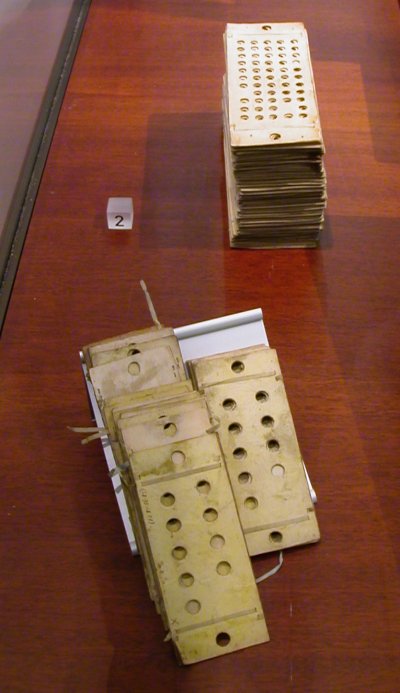
In 1835 Charles Babbage started his work on the first
These are the cards which were used to programme the
Analytical Engine.
analytical engine. However it was in 1940 when the first general purpose machine was actually created due to Babbage struggling to get sufficient funding. The machine would run off of 'formulae' and 'data' which would be supplied by cards with holes punched in them, an idea which originated from an old fashioned loom. The machine also had a large memory capacity, it would be able to store up to 1,000 numbers which could be up to 80 decimal places. Back in the time of the 1830's this was a groundbreaking achievement in regards to technology. This wasn't the first computer to be created, however it was a point in the right direction. 
A couple years before Babble's death he started work on something called the 'Mill.' This would allow his analytical device to preform things such as; addition, multiplication and subtraction. However this unfortunately didn't develop into anything else, when Babbage passed away he wasn't that far off of creating the first computer, this seems like a disappointment, but with the invention of his analytical engine it spread to so much more.

The Babbage Engine (2016) A Brief History (Online) Available from: http://www.computerhistory.org/babbage/engines/ (Last Accessed 14/10/16)